MPB Root Tonic
Earth, Essence, & Shen
Overview:
At the absolute root of Male Pattern Baldness (MPB) is excess bone tissue that accumulates in crown, upper forehead, and forelock areas in certain men after puberty. This extra bone growth rounds, or obscures, the sharp juvenile skull angles that naturally distinguish the forehead (where hair does NOT grow) from the sides and top of the skull (where hair DOES grow). Such excessive bone layering is evidenced below:
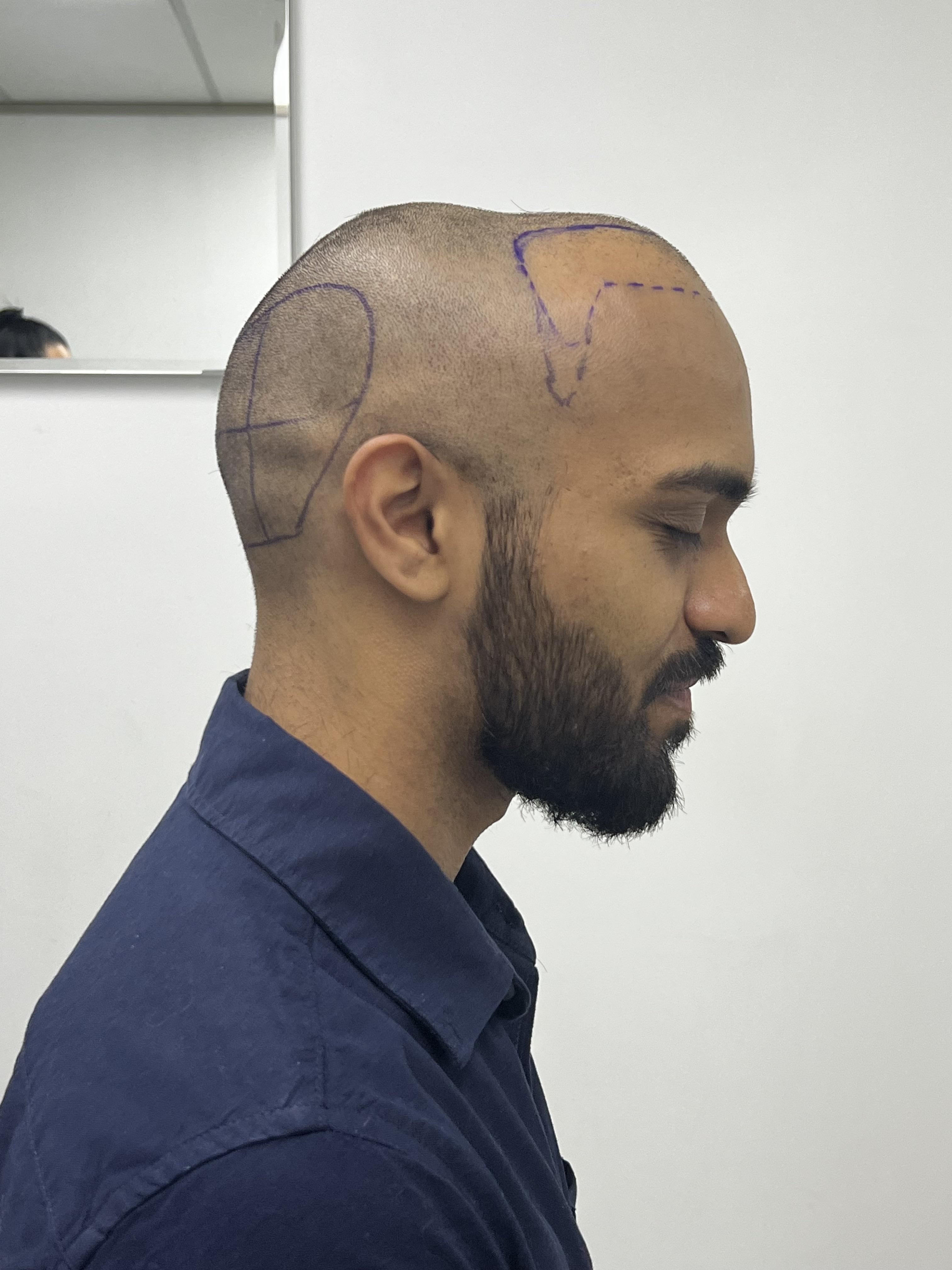

The extra bone tissue is laid down by osteoblasts, the body's bone-forming cells, in order to either (1) reinforce the structural integrity of the skull along the skull sutures, or (2) protect the brain tissue from elevated scalp Heat. This is in response to internal pressure and electrical activity and/or stagnation thereof due to chronic high velocity, and high volume, abstract thinking.
The added bone tissue changes the contours, or angles of the skull, particularly at the hairline, which alters the Etheric Blueprint, or the architectural layout, geometric markers and definitions, of the Physical Body on which the Etheric Body relies to place our Hair and other body parts. The result is pattern "loss". More details on the role of excess bone growth and their role in pattern loss are provided here.
An herbal decoction cannot remove bone tissue. For such, it is necessary to apply separate skull remodelling techniques (see here). However, herbal support can mitigate the effects of pathological imbalance that is still actively triggering the bone layering.
The pathological imbalance that manifests in MPB stems from a disrupted Ke cycle (or restraining relationship) involving the Heart, Spleen, and Kidney organ networks. In particular, an exuberant Heart (Fire), poorly balanced by a depleted Kidney (Water), without the digestive structural stability of the Spleen (Earth), will perpetuate the chronic and compulsive high velocity abstract thinking that is driving the fiery Qi into and around the skull and necessitating the grotesque ossification.
All three of the organs have a role in the imbalance, and all three organs happen to strongly influence Hair growth. Therefore, the herbal strategy of this formula is as follows, and then described in more detail below:
1. Calm the Shen (Heart) - Repair the Parasympathetic Nervous System.
2. Tonify Yin & Essence (Kidneys) - Build Vital Energy.
3. Strengthen the Digestive Fire (Spleen) - Restore proper Nutritive Qi extraction.
The Heart
Within the Heart organ network resides the "Shen", in TCM, which is our Spirit or Consciousness. It governs all mental, emotional, and spiritual activities, serving as the controller of human life and the seat of awareness. In this manner, the Shen is who we are in every non-corporeal sense.
The Heart, and Shen, represent the Fire Element. Fire gives life to our body. Our interests, passions, and desires are an expression of this Fire. When we indulge in them, we are invigorated with abundant energy. When we act contrary to our true self, by contrast, we feel sluggish and depressed. Fueling our Heart-Fire with passions and interests is critical for health and longevity.
However, sometimes, the Heart-Fire can burn too hot. We cannot work indefinitely without rest. We cannot have all excitement without peace. Rather, there must be a balance. Otherwise, the Shen becomes unsettled, and disease follows.
An unsettled Shen pushes the rest of the body into a Sympathetic Autonomous Nervous System state, which is hyper-reactive and energetically draining. This is the state of being in "Fight or Flight" or "Always on." This is a state which, although helpful in crisis situations, will burn through our vital reserves to facilitate a heightened state of mental and physical activity, as needed.
An unsettled Shen, or overactive Sympathetic Nervous System, has 3 distinct pathological influences on the energetic imbalance which culminates in MPB.
1. It fuels the high velocity, and high volume, analytic and strategic thinking that is generating the internal skull pressure and scalp surface electrical heat to which the osteoblasts are responding by laying bone tissue on the skull sutures.
2. It conditions the osteoblasts to be hyper-reactive, as the energy of the Sympathetic Nervous System state influences all physiological processes, encouraging them to lay down even more bone tissue than necessary to reinforce the sutures, which again is to protect the brain tissue from the perceived internal and external threats, thus compounding the skull growth and pattern loss issue.
3. The excess Heart-Fire causes insomnia, restless worrying, and tissue inflammation, which burns through vital reserves at such a pace that chronically depletes the Kidneys (or counter-balancing Water Element), worsening the original imbalance even more so over time, perpetuating the imbalance that is causing pathologies #1 and #2 above.
By contrast, a Shen that is calm results in a Mind that is quiet. The result is that the body settles it physiological processes into a Parasympathetic Nervous System state, which is one that is nurturing and building. This is a goal of the herbal formula, which should be complemented with lifestyle adjustments and other therapies.
Calming the Shen is critical for reversing MPB, because it allows our body to call upon the osteoclasts, the bone REMOVING cells, which are needed to remodel the skull in a flatter and more contoured manner. More importantly, this is the state needed for 99% of the day, and helps us get restful sleep and rebuild our vital reserves in our Kidneys, which is the organ network that is responsible for actually growing the Hair.
The Kidneys
In Traditional Chinese Medicine (TCM), the Kidneys are the organ network that is directly responsible for Hair growth. In fact, it is one of the main principles of Hair in TCM that "the Kidneys manifest in the Hair." Therefore, addressing the root of any Hair-related problem, such as Male Pattern Baldness (MPB), involves correcting an imbalance in the Kidney organ network.
The Kidneys have four distinct energies which manage their network, and they all have a unique role with regards to Hair.
The vast majority of Hair-related diseases trace back to a deficiency in both Kidney Yin and Kidney Essence. These deficiencies create two distinct pathological pathways that result in either thinning or pattern loss, or both.
A Deficiency in Kidney Essence impacts hair density because Kidney Essence directly generates Kidney Qi, and Kidney Qi is responsible for driving the growth cycle of the Hair. Without an adequate Kidney Qi energy supply, Hair follicles prematurely shed and fail to regrow a new shaft. Furthermore, a depleted Kidney Essence will not provide Kidney Qi with enough of the raw materials required to build a healthy Hair follicle, resulting in thinner shafts with less pigmentation. The overall result is sparse and greying Hair.
A Kidney Yin deficiency exacerbates the conditions for pattern loss created by the underlying Ke Cycle disorder involving the Heart, Spleen, and Kidney, as previously discussed. It does so through a pathological impact on the Liver organ network. This is because a TCM principle is that Kidney Yin and Liver Yin "come from the same origin." While the Kidneys represent the Water element, and the source of life, the Liver represents the Wood element, and growth. Just as tree draws up water from an underground reservoir, the Liver Yin draws up moisture and nutrients from Kidney Yin. Without a replete Kidney Yin reservoir, the Liver dries up like a tree without water.
In terms of pattern loss, a deficiency Kidney Yin results in a deficiency Liver Yin. Insufficient Liver Yin, then, will fail to anchor its Liver Yang counterpart, which is aggressive rising and forceful growth energy (Qi) of the Liver. When the Liver Yang Qi rises, it pushes up into the skull, and out of the eyes, jamming up the flow of Qi through the Urinary Bladder, Gallbladder, and Stomach meridians. This generates scalp Heat by means of electrical friction and stagnating electrical energy in those meridians. It also supplements the concentrated electrical energy that is already present in the skull cavity and generating the outward push, thus contributing to both pathologies that trigger osteoblast activity and subsequent pattern loss.
To summarize, when Kidney Essence is depleted, the deficiency manifests in the Hair as greying and thinning. When Kidney Yin is deficient, it will directly impact the Liver network's ability to restrain the forces that cause unwanted post-pubescent skull growth, and pattern loss. In addition, though, deficiencies in either Kidney Yin and Kidney Essence naturally create deficiencies in the other, due to mutual dependence. That is, Kidney Yin is what stores Essence, but Kidney Essence is what generates Kidney Yin. Therefore, the base of the approach in any energetic treatment to address thinning, greying, and pattern loss, is to replenish Kidney Essence and tonify Kidney Yin together.
The Spleen
The main role of the Spleen organ network, which includes the Stomach, is digestion. The Spleen is the Yin organ, and the Stomach is the Yang organ in this pairing. Together they work to extract the Qi from our food, which is combined with respiratory Qi from the Lungs to make Blood. The rest of that extracted Qi is sent down to the Kidneys to be stored as Essence. Thus, the Spleen network is responsible for providing useable energy to run all of our physiological functions, as well as providing the materials to replenish our vital reserves.
Because the Spleen network provides such foundational support for our body, it is represented by the Earth element. While the Kidneys serve the Water element role, the source of the cool and moist fluids that nourish all of our tissues, the Spleen is like the dam that holds that water in a private reservoir. It is from this structure that we best draw up our nourishment. However, if structure of the dam weakens, leaks form. These leaks deplete the water supply, unnecessarily, and result in adequate reserves. Likewise, when digestion is weak (Spleen Qi), it will result in deficiencies in both Essence and Blood, the source of Yin nourishment for the Hair, and the entire body, leading to "age-related" health problems.
Spleen Qi is weakened by irregular meal times, which can be attributed to both intermittent fasting on one extreme and snacking on the other, or simply disorganized daily meal scheduling. In addition, the types of food, such as cold and damp forming foods, and even what time of day that we eat them, e.g. heavy foods at dinner, can overburden the Spleen, leading to incomplete digestion, and energy loss. However, the major source of Spleen function impairment is caused by pathological emotional factors, which involve excessive worry and intellectual thinking. These ultimately originate from a Yang, or male, energy imbalance.
Furthermore, as with Kidney Yin and Essence, the digestive stress and emotional stress that impair Spleen are not mutually exclusive. Excessive worry and thinking will weaken digestion, and weakened digestion will make us more prone to excess worry and thinking. This traps us in a negative feedback loop of perpetual digestive weakening and hyper-sensitivity to stress. This state is what is known in Ayurveda as a Vata imbalance.
A Vata type is someone who expends their mental activity up in the clouds, where the Air and Ether (space) element sit, trapped in their thoughts, worried and scattered, while their bodies tend towards dry, thin, and frail, reflecting their unstable Earth element and depleted Water element components. For this reason, Vata is the constitution that most susceptible to all forms of Hair Loss.
The flighty and fragile mental state of this individual permeates every aspect of the organism, and ultimately manifests in the Hair as dryness and shedding. Furthermore, the hypersensitive nervous system of such an individual chronically triggers the Liver Yang Fire energy to rise and push out on the skull, causing pattern loss.
The best antidote to a Vata imbalance, is to ground that scattered Air and Ether element energies with a heavy dose of Earth element, i.e. Spleen tonification, as well as some rhythm and stillness, provided by the Water element, i.e. Kidney Yin and Essence. Calming the Shen, of course, is a critical in this scenario as well.
The Liver
As previously discussed in "The Kidneys" section, the Liver is directly nourished by Kidney Yin. The Liver function, therefore, is significantly impaired by a disharmony the Heart, Spleen, and Kidney Ke cycle that perpetually depletes Essence and Kidney Yin. It was also noted that a feature of this dysfunction, unanchored Liver Yang Qi in particular, plays a role in pattern loss by exacerbating the energetic pathologies that are contributing to internal skull pressure and external scalp Heat. What has yet to be discussed, however, is how the Liver relates to Hair, how the Hair relates to Blood, and how Blood relates to the Liver.
A second TCM principle in regards to Hair is that "Hair is the surplus of Blood." This means that whatever Blood is left over, after every other thing in the body gets the amount of Blood that it needs first, gets transformed into Hair. In other words, Hair comes last. Therefore, the earliest signs of Blood Deficiency are going to manifest in the Hair, in the form of thinning and greying. The Liver has a key role in many aspects of the quantity and, especially, quality of the Blood.
While the essential materials to make Blood are supplied by the Kidney Yin and Kidney Essence, and thus more directly related to total systematic Blood, the Liver's role in storage of the Blood influences its functional supply. The Liver is responsible for storing, conditioning, and releasing the Blood. The Liver's ability to store Blood depends on its Yin being sufficient to anchor and contain it. When Liver Yin is depleted by Kidney Yin deficiency, the Liver cannot contract and hold Blood in reserve. This means that Blood that would be stored for use otherwise, instead leaks or is wasted. This reduces functional Blood volume in addition to the Blood deficiency already present due to insufficient Kidney Yin.
In addition to the quantity loss, Liver Yin deficiencies can significantly impact the quality of Blood in how it is conditioned by the Liver. For example, when Liver Yin dries out from lack of Kidney Yin nourishment, the Blood stored there becomes thin, and loses some of its nourishing capacity. The Liver Yin Deficiency also generates internal "deficiency" Heat. This Heat evaporates and damages the Blood's cooling, moistening, and calming properties, which further degrades its nourishing capacity and can disturb the Shen, compounding the Heat issue. When Blood is not properly conditioned, as such, whatever Blood does get transformed into Hair from this weak surplus, will not be properly nourished, nor will be made by good quality Blood. The result is weak and lifeless Hair withing the receded pattern loss boundaries.
The other role of Liver is to ensure the smooth circulation of Qi. As previously discussed, without adequate Liver Yin, or cooling fluids of the Liver, the Liver Yang Qi, or fiery electrical energy of the Liver, ascends to the head, which disrupts the smooth flow through the scalp meridians, creating blockages due to high volume flow, counter-directional action through the eye portals, and electrical interference. This directly contributes to bone formation at the sutures, but also impairs Blood flow, as per the TCM principle "Where the Qi goes the Blood flows." As the Hair is directly nourished by the Qi meridians of the scalp, scattered, blocked, and otherwise incoherent Qi flow in that area impairs Blood flow, further compounding the Hair woes of the MPB sufferer.
Therefore, in addition to restoring balance to the Heart, Spleen, Kidney Ke cycle, an effective herbal strategy to address all of the root and branch pathologies must mitigate the following disturbances in the Liver organ network:
• Generate Liver Blood
• Cool the Liver and Liver Blood
• Clear Deficiency Heat
• Anchor the Liver Yang
Disperse Liver Qi
Although the Liver organ network disturbances are being treated as branch pathologies rather than the root pathology, and justifiably so, it may such be that the Liver, ironically, is closer to the root of the imbalance than the corresponding Ke cycle that disturbs it; or, at least, "the spirit" of the Liver.
According to TCM, the Liver houses a sub-spirit of the Shen called "the Hun." It is defined as "the Ethereal Soul," and is responsible for our vision, planning, and life direction, all on a subconscious level. It is a powerful internal force said to be one of the only parts of our non-corporeal self that will accompany us from one incarnation to next. As per its function, it "plans" our incarnations at specific times and places based on vibrational affinities corresponding to the astrological and prevailing collective energies on the Earth, assigning us a premeditated life mission that we begin our journey to discover at the moment of birth, and compels us to move in the direction of that life mission with relentless force.
The Hun appropriately resides in the Liver, which represents the Wood element, and is the energy of growth, or upward ascent to the Heavens from the Earth. Therefore, for us to have the best opportunity to reach our unique destiny, as compelled by the Heavens, in each incarnation, the Hun needs an ample supply of vital Energy from the Kidney Yin and Essence to energize our physical bodies in the correct direction. But, also, just as Wood needs Water to grow, Fire needs Wood to burn. A particularly driven Wood-Hun (e.g. year of the Wood Tiger in the zodiac), especially dried out from lack of Water nourishment, can kindle a raging Heart-Shen-Fire if not properly balanced within the elemental structure and, in that manner, the Liver, or Wood energies, can be both the causative and receiving agent of this imbalanced state.
The Formula:
Traditional herbal strategies advise taking one formula at a time, for an extended period of time, until symptoms improve. Then, the formula can be adjusted or discontinued altogether. Sometimes the complexity of the disease is such that the herbal formula can either address the "Root" or the "Branch" pathologies in a disorder, but not both. In our case, that would be treating Liver Branch pathologies separately, and most likely first. Then, once the major Liver Heat symptoms have been cleared, follow it by treating the underlying Kidneys, Spleen, and Heart imbalance. Fortunately, there is precedent in Chinese Herbal Medicine for treating the Root and the Branch pathologies of this imbalance together.
The formula proposed on this webpage is based on a classic modification of the Suan Zao Ren Tang, or "Sour Jujubee Seed Decoction." The original aim of the formula is to calm the Shen, which has been disturbed specifically by due to Blood Deficiency in the Liver, causing symptoms of insomnia and restlessness. This would address much of the Branch pathologies in the Liver, and a major part of the underlying Ke cycle issue, i.e. a flaming hot Shen.
The classic modification, though, as described by Dan Bensky in "Chinese Herbal Medicine: Formulas and Strategies, is to replace Ligusticum rhizome (chuan xiong), a warm and drying Blood and Qi moving herb, with Kidney and Liver Yin nourishing herbs, Eclipta Alba (han lian cao) and Ligustrum Fruit (nu zhen zi), and the Liver Blood building herb, White Peony (bai shao). This modification adjusts the formula to be more cooling and Kidney Yin and Essence nourishing, in order to treat flaring Deficiency Heat symptoms. In addition, he recommends Schisandra Berry (we wei zi) and Oyster Shell (mu li), when night sweats are experienced, in order to astringe the Essence, and anchor the Liver Yang, respectively.
With the modifications described above, the Suan Zao Ren Tang satisfies all of the Root pathologies for the Heart, Spleen, Kidney Ke cycle disorder, and almost all of the Branch pathologies in the Liver, as outlined in the "Overview" section. Furthermore, the addition of Eclipta Alba adds a potent Hair feature to the formula, as it is a major herb used in both Ayurveda and TCM specifically for Hair disorders, internally and externally. However, it is still lacking one key feature that we need, and is potentially a bit imbalanced.
The removal of Ligusticum rhizome (chuan xiong) negates the need for Anemarrhena (zhi mu) in the formula, which balances the Heat and Dryness created by Ligusticum (chuan xiong). But, it also deprives the formula of its original Qi and Blood moving properties. Dispersing Blood and Qi are important for our purposes. When formulas help build Blood, then it is common to put a Blood moving (or dispersing) herb within it in order to prevent the augmented Blood supply from cloying and stagnation. In regards to Qi dispersal, while we are not building Qi in this instance, Qi dispersal is needed for our purposes to soothe the Liver by helping it to circulate the Qi that has concentrated in the head due to rising Liver Yang. Fortunately, there is precedent for adding two separate Blood and Qi moving herbs into a similar formula, with a similar strategy.
The Zi She Qing Gan Yin is a classic formula used to nourish Kidney and Liver Yin for people experiencing Deficiency Symptoms, such as irritability and insomnia, due to depleted Kidney Yin and Liver constraint. It contains the main herb Suan Zao Ren in its formulation, in order to calm the Shen disturbed by Liver Yin deficiency. It also includes White Peony (bai shao), but along with Bupleurum (chai hu). Bupleurum (chai hu), is a cooling and Qi dispersing herb that is classically paired with White Peony (bai shao) to move stagnant Liver Qi. It is added in small amounts and paired with Liver Yin soothing White Peony (bai shao) so as to not aggravate the rising Liver Yang pathology. Zi She Qing Gan Yin also contains Angelica Root (dang gui), an herb that both builds and moves Blood in the Heart and Liver channels, to sooth the Blood deficiency issue. Adding Bupleurum (chai hu) and Angelica (dang gui), would compensate for the lack of Qi and Blood moving capacity in our formula, without generating Heat, like Ligusticum (chuan xiong).
In regards to rest of the formula, the main body of the formula is the Liu Wei Di Huang, a classic six herb Kidney Yin and Essence building, Heat clearing, and Spleen strengthening formula that serves as a base and stand alone treatment for Kidney Yin Deficiency disorders. This happens to be a formula for which the two herb combo, Eclipta Alba (han lian cao) and Ligustrum Fruit (nu zhen zi), from the modified Suan Zao Ren Tang is a common alternative. Therefore, replacing those six herbs in the Zi She Qing Gan Yin for Eclipta Alba (han lian cao) and Ligustrum Fruit (nu zhen zi) is a clean swap. It even reduces, but not entirely negates the need for Gardenia Fruit (zhi zi), the last herb in the formula, which is there to clear Deficiency Heat, as clipta Alba (han lian cao) and Ligustrum Fruit (nu zhen zi) have Heat clearing capacity. Though, Gardenia Fruit (zhi zi) can be used occasionally, or when Deficiency Heat symptoms are flaring. Finally, Poria (Fu Ling) is retained, a Spleen strengthening and Shen calming fungal herb, as it is already in the Suan Zao Ren Tang. Thus, the following herbal formula can be considered either an modified Suan Zao Ren Tang, modified Zi She Qing Gan Yin, or a hybrid of both.
Kidney Herbs
Eclipta Alba (han lian cao) - Cools the Blood and replenishes the Essence. It clears out the "empty Heat" that has invaded the Blood, while also helping to replenish Yin fluids and Essence. Its Essence replenishing black juice, which runs from its cut branches, and unique Blood nourishing properties make it a potent herb for darkening and enriching the Hair. It is the premier Hair herb in Ayurveda, known as "King of Hair," and often applied topically as an oil (see Bhringraj Oil).
Ligustrum Fruit (nu zhen zi) - Ligustrum is a dark Essence-building fruit that nourishes Kidney and Liver Yin by cooling the body, helping the Kidneys build Yin fluids gradually without having a "cloying effect". In addition, it is a potent deficiency Heat clearing herb. Its ability to tonify Essence and extinguish deficiency Heat pair well with Eclipta to restore the foundation of healthy Hair growth, while neutralizing the pathological disturbances that result in Hair loss.
Heart Herbs
Sour Jujubee Seeds (suan zao ren) - Nourishes Liver Blood and calms the Shen. Its sweet and sour flavor give it an affinity for the Heart and Liver networks, directing is Blood building properties there to anchor "the Hun" and promote sleep, indirectly supporting Kidney Yin.
Angelica Root (dang gui) Angelica tonifies and moves blood. It has a particular affinity for the Liver and Heart networks, making it a potent herb to boost Blood circulation.
Spleen Herbs
Poria (fu ling) - A dual nature herb that strengthens Spleen Qi, as well as drains pathological dampness from it, treating both the root and branch pathologies. Dampness impairs the Digestive Fire, and can accumulate due to diet, as well as from the cold and cloying properties of herbs that are needed to address Yin deficiency. In addition to digestive support, Poria also has a particular affinity for the Heart channel, helping to calm Shen, and ground nervous energy.
Licorice Root (gan cao) - Nicknamed the "Elder Statesman" in TCM, due its unique ability to harmonize the herbs in a formula by buffering their toxic properties, softening strong flavors, and helping the different, often opposing, energies to work together.
Liver Herbs
White Peony (bai shao) - Has an affinity for the Liver and Spleen networks, mainly working to replenish Liver Blood stores. In addition, it astringes Yin fluids, preventing them from leaking out, as well as calms and cools the Liver, which helps subdue Liver Yang.
Bupleurum (chai hu) - Disperses Qi. Helps clear out any stagnation or blockages, helping the Liver restore free-flowing Qi, and its cooling nature does not aggravate Deficiency Heat.
Optional/Occasional Herbs
Oyster Shell (mu li) - Anchors Liver Yang. The heavy mineral nature of the Oyster Shell pulls down energy in body, i.e. rising Qi, which helps calm the Mind. In addition, it generally supports Kidney and Liver Yin through its cooling nature.
Schisandra Berry (wu wei zi) - Astringes the Kidney Essence and calms the Shen. Uniquely possesses all five classical tastes (Sour, Bitter, Sweet, Pungent, Salty). Therefore, it enters all 12 meridians, but with a focus on the Kidneys and Heart. It's dominant sourness locks the Kidney Essence in place, preventing loss via leakages, and its bitterness anchors the Shen.
Gardenia Fruit (zhi zi) - Strong Heat clearing herb that works in the Heart and Liver channels. Specifically used in classic TCM formulas to deal with Heat due to Liver constraint and Yin deficiency.
Note that, the Kidney Yin and Essence tonifying herbs are treated as the "King herbs" in this formula, due to their direct Hair impact. However, individual constituents can be adjusted to focus on the pathologies that are more pressing. For example, if insomnia is a problem, then the formula can be rebalanced to favor Sour Jujubee seeds, by increasing that constituent, and reducing others. Amounts of other herbs can also be increased or decreased, depending on individual weakness.
Where to Buy Bulk Herbs:
I buy herbs from varying sources, depending on prices and availability. The following is a list of herb sources that I recommend.
• https://1stchineseherbs.com/. Fair prices, good quality, and quick shipping.
• https://laherb.com/. Good prices and variety. Often have 25% off deals. Shipping is good.
• https://plumdragonherbs.com/. Low prices and frequent deals. Shipping can be slow.
Note that, Oyster Shells can be bought by buying fresh oysters, and saving the shells after consuming. Be sure to wash and sun-dry the oyster shells for storage.
How to Decoct:
Gather the following amounts of herbs:
1. Lightly crush Sour Jujubee Seeds, and put in a ceramic or stainless steel pot. If using Oyster Shell, then break shells into dime sized pieces and include with Sour Jujubee seeds, or set aside. Put all other herbs into a separate glass or ceramic container.
2. Pour approximately 3 cups, or 800 ml, of water TOTAL over the Herbs. About ⅔ will be needed to cover the herbs in the bowl, and ⅓ is needed to cover the Sour Jujubee Seeds. Let the herbs soak for 30 minutes, up to a couple of hours, to help break down the fibrous roots and shells. Oyster Shells do not need to be soaked.
Note: Ideally, use spring water. If not, use carbon filtered water (such as with a Berkey Filter*), and structure it (such as with an Analemma Wand).
3. After 30 minutes, add the Oyster Shell to the Sour Jujubee seeds if using, and bring the ceramic or stainless steel pot containing the Sour Jujubee Seeds (and perhaps Oyster Shells) in water to a boil. Then cover, and reduce to low heat for 20 minutes.
4. After 20 minutes, add the other soaked herbs (with water) to the pot. Bring to a vigorous boil, uncovered, for 3-5 minutes. Then, cover and reduce the heat to low.
5. After 40-55 minutes, strain the liquid from the herbs through a fine mesh metal strainer. Store the decoction liquid in a thermos.
Note: The goal is to yield 1 cup of strained liquid, ideally. So, if there only remains 1 cup of liquid in the pot at any time between 45 and 60 minutes, then strain immediately. If there is more than 1 cup that remain after 60 minutes, however, then strain anyway. DO NOT boil for longer than 60 minutes.
6. Put the strained herbs, i.e. dregs, back in the pot. Refill the pot with slightly less water (~ 2.5 cups).
7. Repeat the cooking process, i.e. 3-5 minutes of vigorous boil followed by 42-57 minutes of covered simmer. This is the Second and Final Boil.
Note: Some sources recommend cooking for less time during the second boil (30-40 minutes).
8. Strain out the liquid when either 1 cup remains, or time has expired.
Note: When straining the liquid, after either boil, give the herbs a light squeeze, such as pressing with a wooden spoon. But, do NOT try to wring out every drop of liquid.
9. Combine the liquid from the First Boil with the liquid from the Second Boil, and filter through a food-grade cloth filter (see note) to filter out the sediment. The total liquid is divided into two doses to be taken twice per day, if using a strong dose, or divided into four doses to be taken twice per day, if using a weak dose.
Note: I use a 35mm raw silk noil cloth, that I blanched in boiling water for 10 minutes one time before using the first time, and have only cleaned with hot water to reuse. Such a fabric can be bought here.
Storage: The amount of liquid that is to be used the day it is decocted may be stored in a thermos until used. Any liquid to be used the following day, however, must be put in an ice bath to cool, then stored in the refrigerator immediately. Note that decoctions last 48 hours maximum when stored properly.
Additional Instructions:
• The two daily doses must be spaced at least 5-6 hours apart. Generally, this translates to once in the morning and once in the evening.
• Wait at least ½ hour before eating, or 1 ½ hours after eating when taking a dose.
• Always reheat before drinking. To reheat, gently warm the refrigerated liquid for 2 - 3 minutes on the stove until warm. Never bring to a boil.
• Take 30 minutes before or 20 minutes after moderate to vigorous exercise.
• Do not take decoctions near to applying hair oils, hair washing, or any other hair or scalp stimulation or botanical manipulation.
• Dosage: Ideally 1 cup = 1 dose. However, if more than 2 cups yield from the decoction process, divide whatever that is into 2 doses, and drink that.
Modifications:
• Add Gardenia Fruit (Zhi zi) if Deficiency Heat symptoms are expressing as persistent or severe acne in the scalp and face. May be more appropriate in the Summer, than the Winter.
• Add the Oyster Shell (mu li) and Schisandra Berry (wu wei zi) once or twice per week, or if Deficiency Heat is being expressed in the form of night sweats or nocturnal emissions.
Optional Alchemy:
In classical Hair and Yin formulas, Ligustrum is prepared by steaming in honey-wine (mead) overnight, then sun-dried, in order to maximize it's Yin tonifying effect in the Kidney and Liver networks. To make honey-wine, or mead: (1) dissolve 1 part honey in 5 parts water; (2) leave on the counter, shaking or stirring vigorously 2 - 3 times per day for 3 weeks; leave to ferment for 2-3 months while occasionally stirring to prevent mold growth. Then, to process the Ligustrum: (1) submerge the dried ligustrum just barely in the mead; (2) soak for 24 - 48 hours, until liquid is absorbed; (3) steam the soaked ligustrum, elevated, in pot for 3 hours; (4) Sun dry for 2 days. The resulting berries will be much darker, and hence much more potent in the Kidney meridians.
Ligustrum may be still be decocted in its raw form for a less potent, but still therapeutic effect. However, the more adventurous, and alchemically inclined, can attempt these additional preparation methods as their confidence and herbal skills evolve and grow over time.